
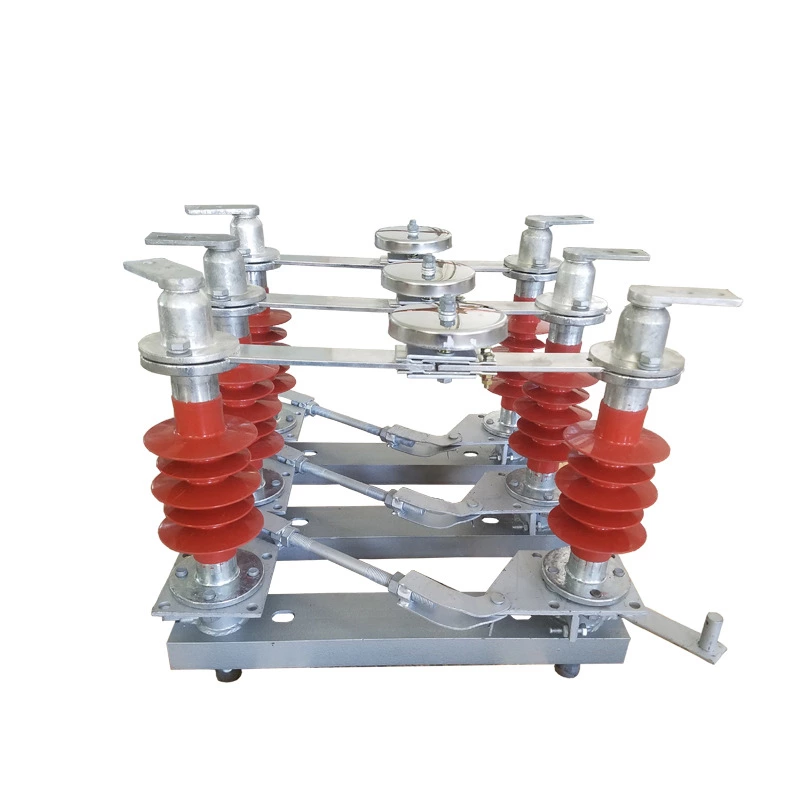
Railway disconnectors and load breakers are specialized switching devices designed for the safe disconnection, sectioning, and switching of railway catenary systems. They provide reliable protection for traction substations, overhead lines, switch points, and sections of electrified tracks.
This equipment operates under demanding conditions: high currents, mechanical loads, vibrations, and environmental influences. Therefore, railway disconnectors feature a reinforced design, durable insulators, and mechanisms that ensure long-term operation.
Purpose of Railway Disconnectors and LBS
Sectioning of 15 kV / 25 kV AC or 3 kV DC catenary systems.
Isolating individual track sections for maintenance or emergency work.
Protecting traction substations and power transmission lines.
Switching at turnouts, depots, and technical stations.
Ensuring the safety of personnel during maintenance of the contact network.
Use in automatic and remote control systems.
Minimum and Maximum Technical Specifications (General Ranges)
Disconnectors (Disconnector / Isolator)
Voltage Class: 15 kV, 25 kV AC; 3 kV DC (confirmed by images from Hughes Power Systems and GW4 15 kV)
Rated current: 630–4,000 A (confirmed by R&S models up to 4,000 A)
Types: knife-type, vertical-break, double-break, pole-mounted (confirmed by images from SHD and GW4)
Load Break Switches (LBS)
Voltage class: 10–33 kV (for traction substations and distribution nodes) (confirmed by SF₆ LBS 33 kV 630 A)
Rated current: 400–1,250 A
Types: SF₆, air-insulated, vacuum; indoor/outdoor; motor-driven and manual (confirmed by the Lucy Electric and FN7–24 series)
Design Features
Enhanced mechanical strength for railway conditions.
Resistance to vibration, contamination, and icing.
Remote control capability (motor drive).
Installation on supports, crossarms, and metal structures.
What We Can Supply and Provide
We supply disconnectors and LBS from any brand—we select solutions tailored to the specific requirements of railway infrastructure.
We design switching nodes for the catenary system, including sectioning, grounding, and remote control.
We perform installation, configuration, commissioning, and maintenance.
We provide a warranty covering all stages—from equipment selection to commissioning.
Warranties and Liability
We ensure that the equipment complies with EN 50152‑2 standards and the requirements for railway electrification. We monitor the quality of deliveries and guarantee the stable operation of switching devices within the catenary system.
BUYER FEEDBACK